Swim
Best Fabric for Swimwear: How to Choose Swimsuit Material
Last updated
Back to blog
Best Fabric for Swimwear: How to Choose Swimsuit Material
The best fabric for swimwear is a warp-knitted blend of nylon or polyester with elastane, usually 10 to 22% elastane. Which blend is right depends on how the suit is worn, printed and lined. This guide walks through those decisions in the order a swimwear factory makes them.
Knowing how to choose swimwear fabric comes down to five calls: base yarn, elastane, weight, finish and lining. After those come the swatch tests and the claims you can legally print on a label.
We make swimwear in Bali, so we look at swimsuit material from the cutting table, not the shop floor. Every section ends with what we’d pick for a first collection and when we wouldn’t. Where we give an example fabric, it comes from a well-known Italian mill, so you can look it up and compare.
Short on time? Here’s the starting point for most first collections. Use a nylon and elastane fabric for solids and a polyester and elastane fabric for prints, both around 190 g/m². Line every piece, add a third layer on whites and pale colors, and pick colors the mill already has in stock.
Swimsuits are made of a synthetic base yarn, either nylon (also called polyamide) or polyester, knitted together with elastane. A typical swim fabric is about 78 to 90% base yarn and 10 to 22% elastane. Natural fibers don’t belong in the suit itself: cotton holds so much water that the suit sags.
The ratio matters more than most founders expect. A fabric with 10% elastane and one with 22% won’t fit, hug or recover the same way on the body. The spandex section below covers why.
How swim fabric is made
- Yarn. The mill starts with nylon or polyester filament plus elastane. Recycled nylon such as Aquafil’s ECONYL comes from nylon waste like fishing nets, carpet and fabric scraps.
- Knitting. Swim fabric is usually a warp knit, often sold as tricot. The yarns run lengthwise, which gives strong stretch and resistance to runs. Italian mill Carvico has made warp knits since 1962.
- Dyeing. Nylon takes acid dyes. Polyester takes disperse dyes, which is what makes sublimation printing possible.
- Finishing. The fabric is set to its final width and weight. Carvico’s VITA, for example, leaves the mill 150 cm wide at 190 g/m², on 70 m rolls.
Tricot describes how the fabric is knitted, not what it’s made of. A tricot can be nylon or polyester, so always read the fiber content too.
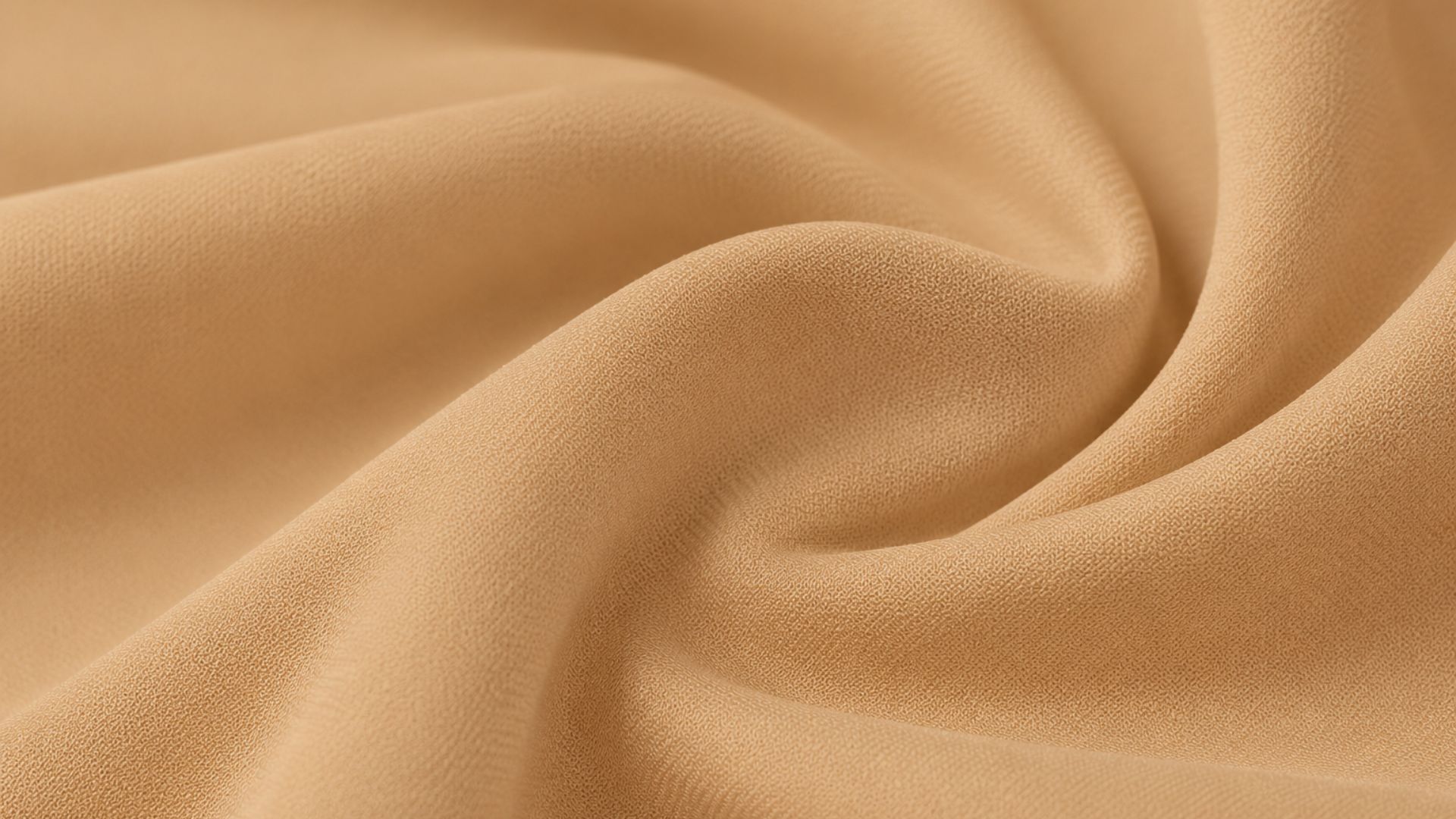
What we’d pick: a warp-knitted nylon or polyester with double-digit elastane.
When we wouldn’t: anything with cotton, linen or viscose in the body, however good it looks dry.
Nylon vs polyester: which is the best fabric for swimwear?
For solid colors, nylon is usually the best fabric for swimwear, because it has a softer hand. Both fibers take prints, by different routes: nylon is printed digitally with acid dyes, and polyester by sublimation. On chlorine, the elastane and the mill matter more than the nylon vs polyester choice.
| Nylon (polyamide) | Polyester | PBT blend | |
|---|---|---|---|
| Mill example | Carvico VITA: 78% recycled polyamide, 22% elastane, 190 g/m² | Carvico Brisbane Recycled: 82% recycled polyester, 18% elastane, 190 g/m² | Carvico Sydney Eco: 51% recycled polyester, 49% PBT, 170 g/m² |
| Dye route | Acid dyes | Disperse dyes | Ask the mill |
| Printing | Digital printing with acid dyes, plus a longer fixation step | Sublimation | Ask the mill |
| Chlorine, per the mill | Ultra chlorine resistant | Chlorine resistant | Chlorine-proof |
| Best for | Solids and soft prints | Prints | Competition and lap swim |
Guides online disagree on which fiber wins on chlorine. Some rate nylon poorly; others say nylon comes out ahead. Both camps miss the bigger factor. Carvico and LYCRA build their chlorine claims around the elastane, not the base yarn.
Carvico says its elastomers resist chlorine, sunscreen and oils more than twice as well as the standard. LYCRA says XTRA LIFE lasts up to 10 times longer than unprotected spandex. When you compare nylon vs polyester swimwear, ask which elastane each fabric uses before anything else.
Both fibers can be printed digitally, but the routes are different. Polyester is printed by sublimation: heat and pressure move the dye from transfer paper into the fabric. There’s no pretreatment, steaming or washing, so a printer can run exactly the meters a style needs. Nylon is printed with acid inks. The fabric is pretreated, printed, steamed to fix the color, then washed and dried. Those extra steps add time, water and equipment, which tends to push minimums and lead times up. We print our women’s swim prints on polyester, in-house in Bali. See how we print swim fabric.
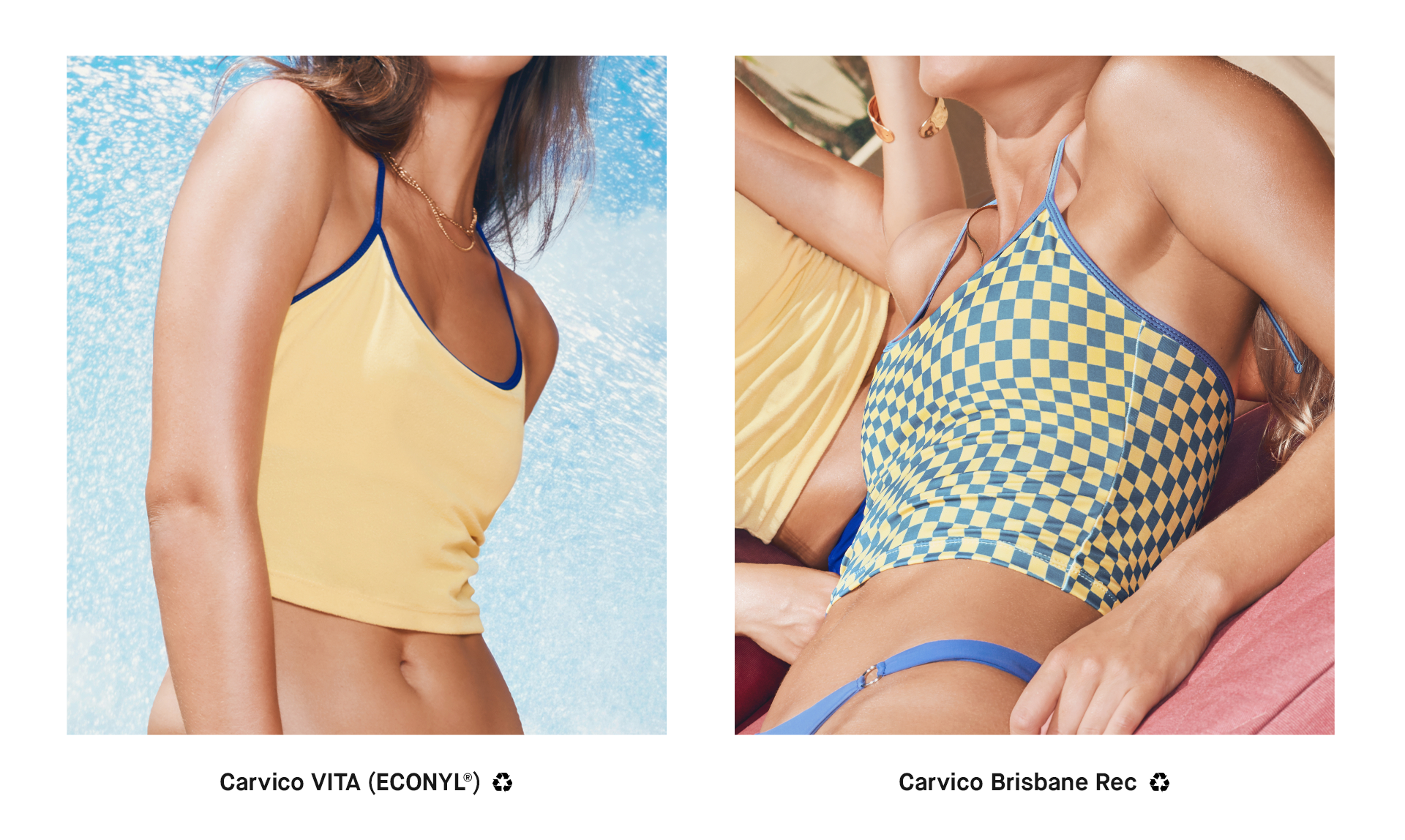
What we’d pick: nylon for solids and polyester for prints.
When we wouldn’t: for a lap swim or club team line. There, a polyester and PBT blend such as Carvico Sydney Eco, listed by the mill as chlorine-proof, is the better fit. If your brand needs a print on nylon, plan for the slower dye route.
How much spandex should swimwear have?
Most swimwear fabric has 10 to 22% spandex, and about 10% is the floor for a suit that stays in place. Fashion swim bases from Italian mills tend to sit higher, from 14% in a metallic jersey to 22% in VITA. More elastane means more stretch and grip, but also more of the fiber that chlorine and sunscreen attack.
Spandex and elastane are two names for the same stretch fiber. LYCRA is one brand of it, with its own labeling rules. The percentage drives three separate things:
- Stretch: how far the fabric goes when pulled. It decides how easily a suit goes on.
- Recovery: how fully it snaps back. It decides whether the seat bags after one summer.
- Compression: how firmly it holds the body. It decides support and how smooth a one-piece looks.
A sleek one-piece for laps needs strong recovery and compression. A ruched one-piece for lounging can trade some control for softness or shine. Metallic and glitter finishes change the balance too, often adding stretch but reducing recovery.
What we’ve seen: founders often compare fabrics by the fiber content alone. But the label only tells you what a fabric is made of, not how it’s knitted or how heavy it is. We’ve worked with two fabrics that were both 87% nylon and 13% elastane. One was a thick, ribbed fabric at 250 g/m². The other was a thin, smooth fabric at 190 g/m². Same label, completely different look, feel and fit. Always judge the swatch, not the label.
Elastane is the part fiber makers protect, against chlorine, sunscreen, lotion, heat and UV. Put these care rules on your hang tag, with the reason, so customers actually follow them.
- Rinse in cool fresh water after every swim. It stops chlorine and sunscreen working on the elastane.
- Hand wash and skip the dryer. Heat damages elastane.
- Dry in the shade, not in direct sun. UV breaks down the stretch yarn.
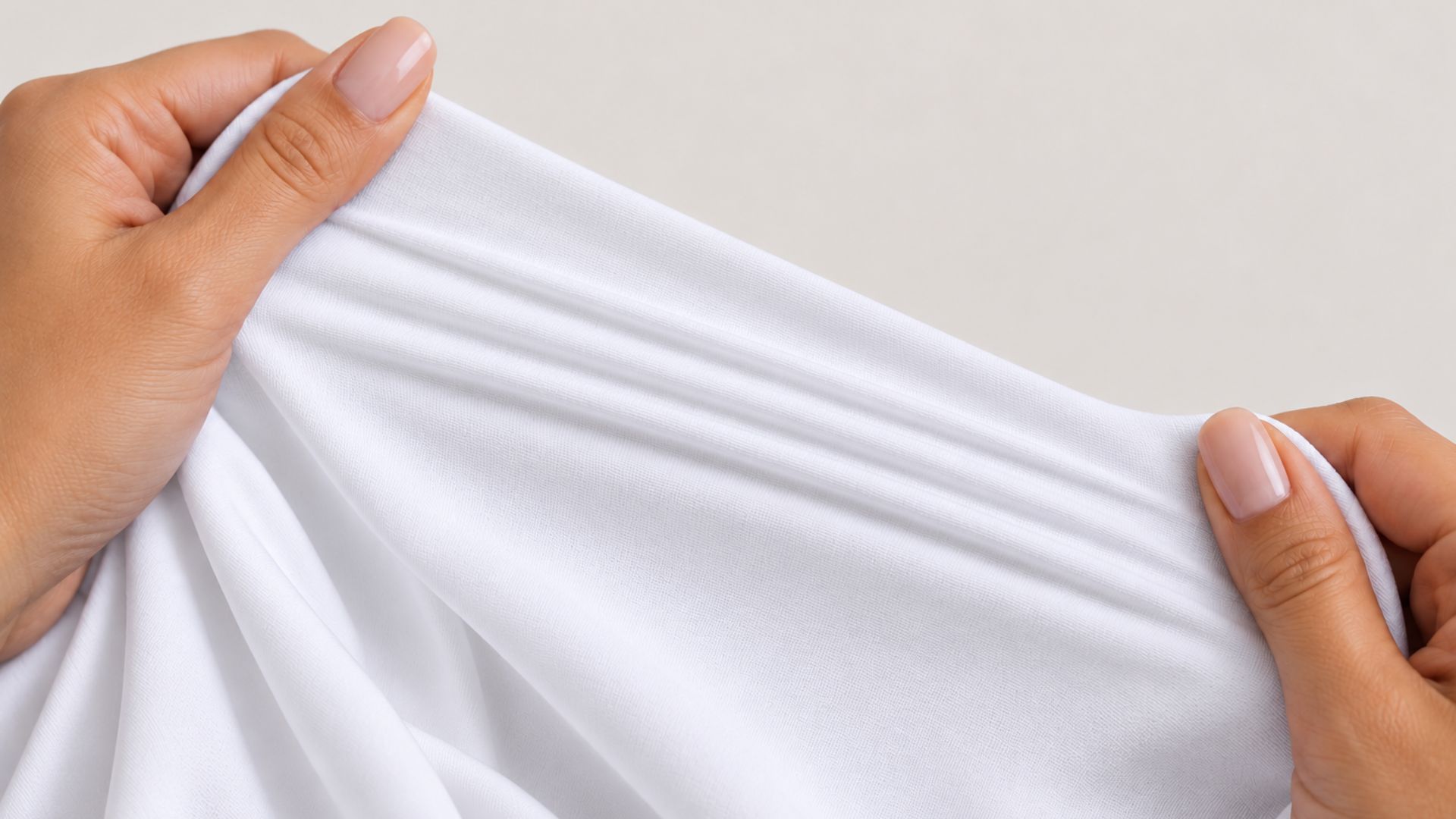
What we’d pick: 18 to 22% elastane for bikinis and one-pieces.
When we wouldn’t: for textured fabrics like crinkle. Their stretch comes from the texture as much as the elastane, which is how a good crinkle can fit XS to XXL in one size. Judge a crinkle on how it stretches and recovers, not on its elastane percentage.
What GSM is best for swimwear?
For most swimsuits, about 170 to 215 g/m² is the working range. Competition fabrics sit at the light end, and metallic jerseys at the heavy end. Textured fabrics run much heavier, with crinkles reaching 600 to 650 g/m².
GSM means grams per square meter of a single layer. Swimwear fabric GSM tells you weight and body, not quality. Remember the lining, too. A suit self-lined in a 190 g/m² fabric puts two layers, about 380 g/m², against the body.
| Weight | Typical fabric | In the hand | Good for |
|---|---|---|---|
| About 170 g/m² | Polyester and PBT competition fabric | Light | Lap and training suits |
| About 190 g/m² | Smooth nylon or polyester jersey | Light and smooth | Most bikinis and one-pieces |
| About 215 g/m² | Metallic jersey | Denser, with sheen | Statement one-pieces |
| About 250 g/m² | Rib | Structured | Textured bikinis |
| 600 to 650 g/m² | Crinkle | Thick and springy | One-size styles |
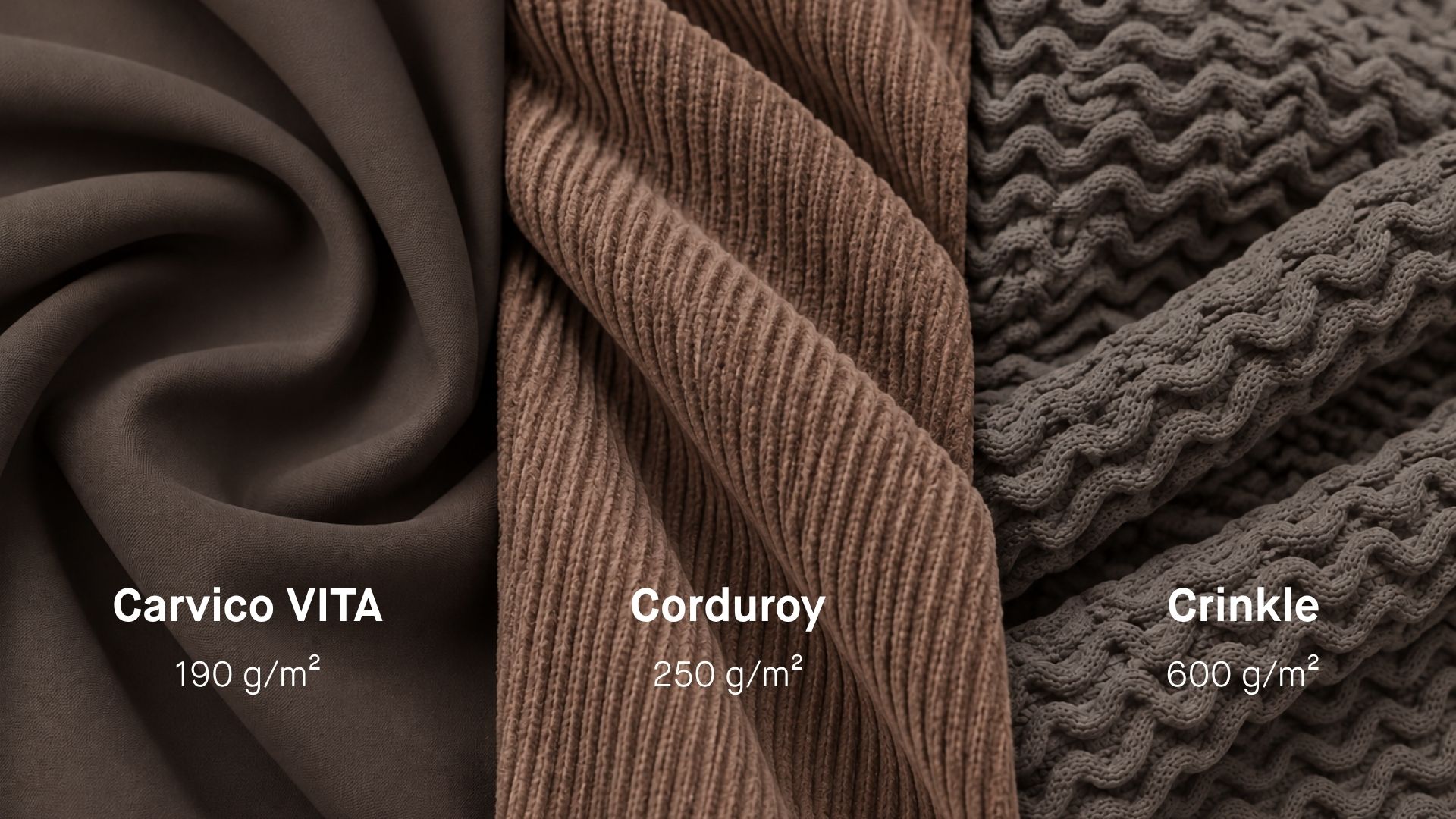
What we’d pick: around 190 g/m² for a first collection.
When we wouldn’t: when the texture is the design. A 250 g/m² rib holds its shape on a structured bikini.
Matte, shiny or textured: which finish suits your line?
There’s no single best finish. Matte is the most forgiving, shine gives a suit instant presence, and texture adds interest while hiding small fit issues. The right choice depends on your silhouette and how much attention you want on the fabric itself.
Here’s what each finish brings:
- Matte: smooth nylon or polyester jersey with a soft, low-sheen surface. It’s the most forgiving finish to fit and sew, and it works across almost any style.
- Shine and metallic: a glossy face, sometimes with metallic yarn knitted in. Shine reflects light, so it shows off the body’s shape and the suit’s construction. It looks its best with clean lines and precise sewing.
- Rib: raised lines knitted into the fabric. It’s heavier and more structured, and forgiving on fit.
- Crinkle: a puckered surface with a lot of give. Its stretch comes from the texture as much as the elastane, which makes it ideal for one-size styles.
- Terry and 3D: looped and raised surfaces that bring texture to the front. See our guide to textured swim fabrics.
Neoprene, velvet, mesh and crochet turn up in mood boards too. They work best as accents, so sample them early. If you want stretch yarn made partly from plants, LYCRA makes a renewable XTRA LIFE version that is 70% plant-based.
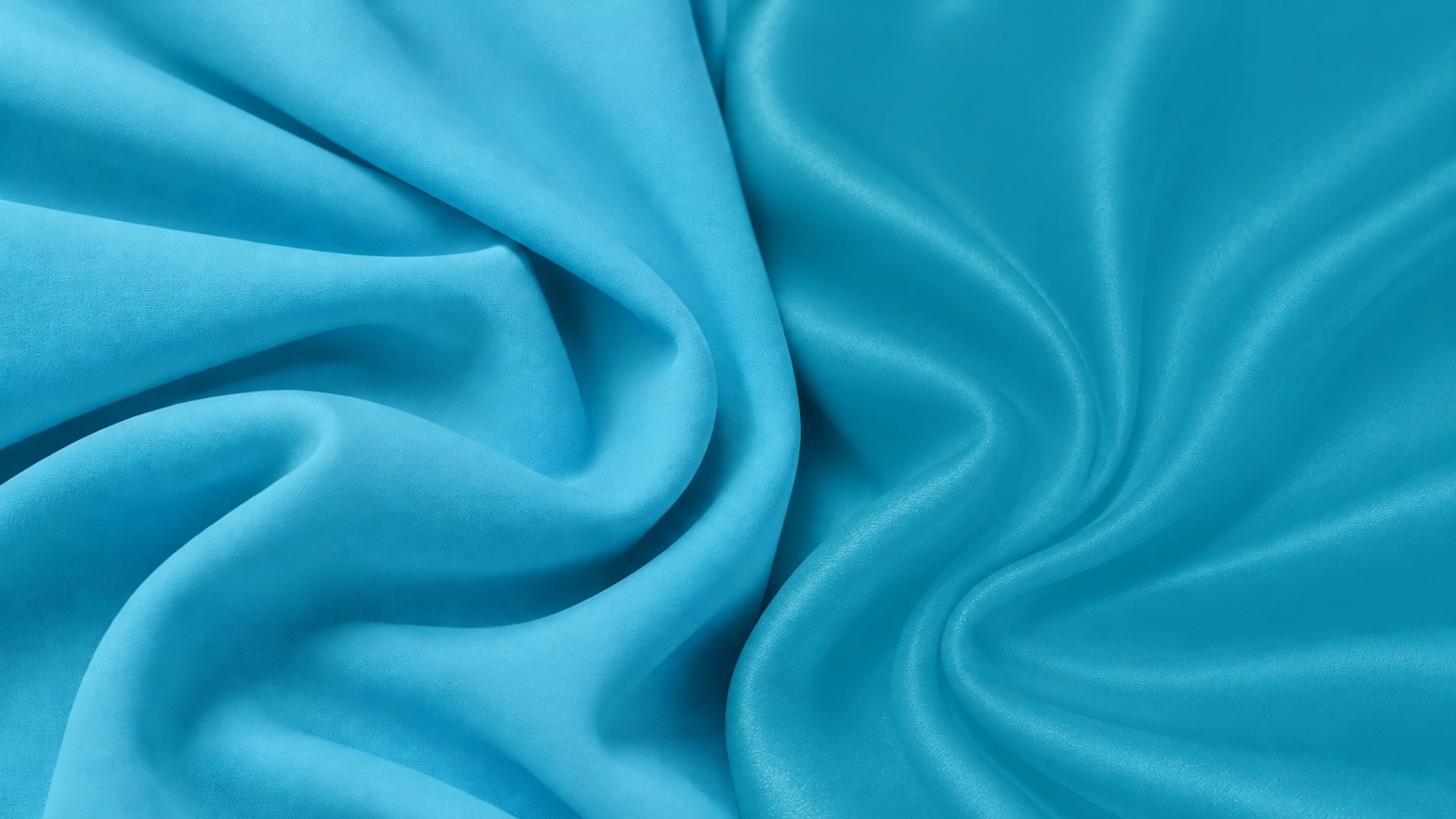
What we’d pick: one core finish for most of the line, matte or shine depending on your brand, plus one texture for a hero piece.
When we wouldn’t: mixing too many finishes in a first collection. With around 100 pieces, one core finish plus one hero texture keeps the line coherent and reorders simple.
Why does swimwear go see-through, and how should it be lined?
Swimwear can turn see-through when water and stretch open up the knit, and light colors show it first. Not every swim fabric on the market is fully opaque, either. A good lining solves most of it, and light colors are worth checking wet before you commit.
There are three common ways to line a suit:
- Self-lining: the outer fabric used again on the inside. It stretches and recovers with the outer layer.
- Swim lining: a lighter fabric made for the job, often 100% nylon in ready-to-wear suits. It adds less bulk.
- Power mesh: a nylon and spandex mesh with strong recovery. It adds support to one-pieces and shaping styles.
Whatever you choose, the lining should stretch in the same directions as the outer fabric. Wet fabric is also less protective. ARPANSA (Australian Radiation Protection and Nuclear Safety Agency) notes that UV protection drops when fabric is wet or stretched.
Light colors are worth a closer look. Whites, creams, pale pastels and some bright pinks can look fully opaque on a dry swatch, yet show through two layers once wet and stretched.
Our approach: we self-line every suit, because a same-fabric lining moves with the suit and doesn’t pucker or ride up. For whites, creams, pale pastels and other light colors, we add a third layer of fabric for full coverage. It adds a little weight and fabric cost, and it keeps light colors on the table.
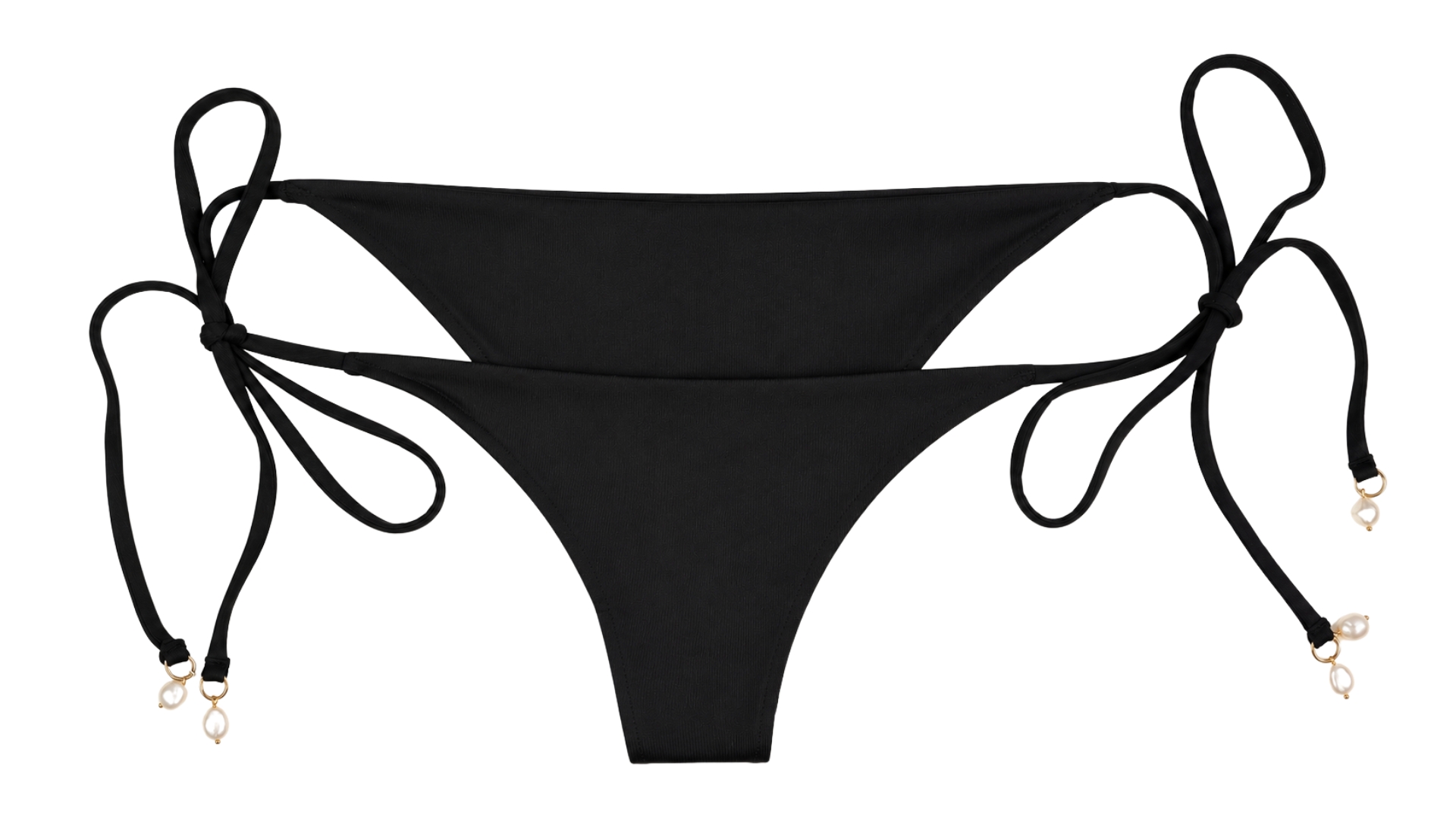
What we’d pick: a self lining on every piece, plus a third layer for light colors.
When we wouldn’t: a third layer on dark solids. It adds bulk with no gain in coverage.
Is recycled swim fabric as durable as new?
Yes. Recycled nylon is as durable as new nylon when it’s the same polymer. Aquafil says its ECONYL regenerated nylon is the same as new nylon, so durability comes down to the elastane and the mill.
The footprint numbers come from Aquafil. It reports up to 90% lower global warming impact for ECONYL. By its figures, every 10,000 t of ECONYL saves 70,000 barrels of crude oil and avoids 65,100 t CO2e.
Recycled polyester swim bases exist too, and some carry GRS and RCS certification, such as Carvico Brisbane Recycled. At our factory, recycled is now the default: 95% of the fabric we use is recycled. For more, see our guide to sustainable swimwear fabrics.
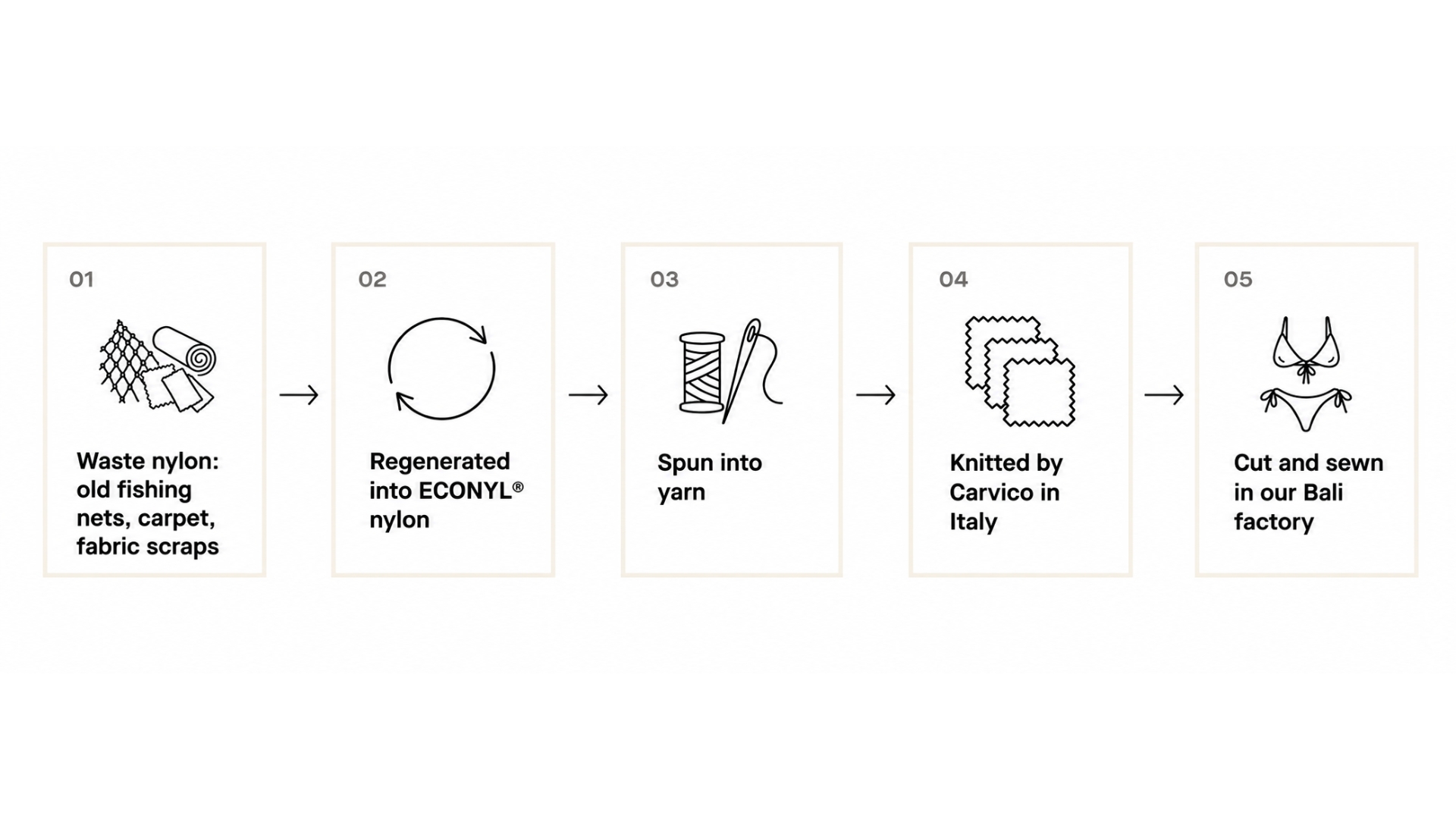
What we’d pick: recycled as the default for every style.
When we wouldn’t: when you plan a recycled claim on the label but can’t get certificates for that exact fabric. Read the next section first.
What fabric claims can you put on a swimwear label?
You can only put fabric claims on a swimwear label that your certificates and test reports back up. Exact fiber composition is the baseline. Words like “recycled”, “eco-friendly” or “UPF 50+” need proof, and EU rules got stricter in 2026. This isn’t legal advice, so check your markets with a compliance advisor.
Recycled claims: GRS vs RCS
Both standards verify recycled content through scope certificates and transaction certificates.
| RCS | GRS | |
|---|---|---|
| Checks | Recycled content | Recycled content, plus social, environmental and chemical rules |
| Minimum recycled content | 5% | 20% for business sales, 50% for consumer labels |
| Proof | Scope and transaction certificates | Scope and transaction certificates |
Source: Textile Exchange, SGS
Ask your factory for the certificates that cover the exact fabrics in your order, and check the expiry dates.
What we’ve seen: recycled fabric alone doesn’t give a brand a recycled claim. The certificate chain has to reach your product.
Selling in the US or the Middle East? Check label rules for each market with your compliance advisor.
EU green claims
EU Directive 2024/825 has applied since 27 September 2026. Generic claims like “eco-friendly” or “green” are banned without recognized proof. The ban covers stock already on shelves.
UPF claims
Under AS/NZS 4399:2020, UPF 50 and 50+ rate as excellent protection. Protection drops when fabric is wet, stretched or worn. Bikinis and other low-coverage pieces can’t make sun protection claims there, whatever the fabric rating.
What we’ve seen: brands ask for UPF 50+ hang tags on bikinis. In Australia and New Zealand, the standard doesn’t allow it. A mill’s UPF figure is supplier data, like the UPF 50+ listed for Carvico Sydney Eco. A claim on your tag needs a lab report for that fabric.
OEKO-TEX and LYCRA
OEKO-TEX STANDARD 100 tests for harmful substances across four product classes. Class II covers items in direct contact with skin. The LYCRA name can only go on a consumer tag if the fabric is certified for it.
Sample tag wording:
- "78% polyamide, 22% elastane”: exact composition, the baseline.
- “78% recycled polyamide”: a recycled claim, even inside a composition line. It needs certificates for that fabric.
- “Eco-friendly” on its own: avoid in the EU.
- “UPF 50+” on a bikini: not allowed in Australia and New Zealand.
What we’d pick: exact composition on every label, plus recycled claims backed by certificates for that fabric.
When we wouldn’t: “eco-friendly” on its own in the EU, or UPF on bikinis for Australia and New Zealand.
Best fabric for swimwear by style: bikinis, one-pieces and more
The best fabric for swimwear changes by style. Solid bikinis and one-pieces suit a soft nylon base, and prints suit polyester. A hero piece can carry texture or shine, and training suits need a chlorine-proof polyester or PBT blend.
| Style | Fiber | Elastane | Weight | Lining |
|---|---|---|---|---|
| Solid bikini or one-piece | Nylon | 18 to 22% | About 190 g/m² | Self-lined, third layer on light colors |
| Printed bikini or one-piece | Polyester | About 18% | About 190 g/m² | Self-lined or swim lining |
| Shaping one-piece | Nylon or polyester | 18 to 22% | About 190 g/m² | Power mesh for support |
| Statement one-piece | Metallic jersey | About 14% | About 215 g/m² | Self-lined |
| Textured bikini | Rib | About 13% | About 250 g/m² | Self-lined |
| Lap and training suit | Polyester and PBT | Check the spec | About 170 g/m² | Check the style |
What fabric choice does to cost and lead time
- Stock colors are the fastest and cheapest route.
- Custom colors carry mill minimums and a longer lead time.
- Your own fabric is often possible, with full specs plus sampling.
- Lining adds fabric to every suit. Self-lining doubles it, and a third layer adds more.
- Duty depends on where the fabric comes from and where the suits are sewn.
Factories also set minimums per style and color. Ours is 20 pieces per style per color or print, with no minimum per size. That means a 100-piece first collection could be five styles in one color each. See costs and minimums.
What we’d pick: stock colors on a nylon base and a polyester print base for collection one.
When we wouldn’t: when one exact color is your brand. Then a custom color or your own fabric is worth the wait.
How to choose swimwear fabric: 5 tests before you order
You learn how to choose swimwear fabric by handling it, not reading about it. Screens don’t show true color, and a composition line won’t tell you how a fabric behaves. Run these five tests on every swatch you’re considering.
- Stretch. Pull the swatch hard in both directions. Pass: smooth, even color. Fail: the knit opens and shows the elastane underneath.
- Recovery. Hold it stretched for a slow count of ten, then let go. Pass: it lies flat again. Fail: it stays wavy or longer than it started.
- Wet see-through. Wet it, stretch it over a dark card and check in daylight. Pass: no shadow through two layers. Fail: add a third layer or pick a darker color.
- Sunscreen. Rub sunscreen in, leave it for an hour, then rinse. Pass: no stain or stiff patch. Fail: pick another color or base.
- Wash. Hand wash and shade-dry it a few times, then compare it with an untouched swatch. Pass: same color, size and snap. Fail: fading, shrinking or a limp feel.
Feel the 5 tests on real fabric. Our swatch book comes in the Starter Kit, so you can run every test above before you choose a single color.
Swimsuit material glossary
These are the terms you’ll hear when you talk swimsuit material with a factory or mill.
- Acid dye: dye used for nylon, with a longer fixation step.
- Bonded factory: a factory that can import materials duty-free for production.
- Compression: how firmly a fabric holds the body.
- Custom color: a color dyed to order by the mill, with minimums and a longer lead time.
- Denier: a measure of yarn thickness.
- Disperse dye: dye used for polyester, and the basis of sublimation printing.
- ECONYL: Aquafil’s regenerated nylon, made from nylon waste.
- Elastane: the stretch fiber in swim fabric, called spandex in the US.
- Four-way stretch: stretches both lengthwise and widthwise.
- GRS: Global Recycled Standard. Verifies recycled content plus social, environmental and chemical rules.
- GSM: grams per square meter of a single fabric layer.
- LYCRA: a brand of elastane. The name needs certification on consumer tags.
- OEKO-TEX STANDARD 100: a harmful-substance test with four product classes.
- PBT: a fiber used in chlorine-proof competition fabric.
- Power mesh: a stretchy mesh with strong recovery, used to add support.
- Print strike: a test print approved before cutting.
- RCS: Recycled Claim Standard. Verifies recycled content of 5% or more.
- Recovery: how fully fabric returns to shape after stretching.
- Scope certificate: shows a company is certified for a standard.
- Self-lining: lining made of the same fabric as the outside.
- Stock color: a color the mill or factory keeps on the shelf.
- Sublimation: heat printing with disperse dyes, which works on polyester.
- Transaction certificate: proves certified content in a specific shipment.
- Tricot: a common type of warp knit, named for how it’s knitted, not its fiber.
- UPF: Ultraviolet Protection Factor. UPF 50 and 50+ rate excellent under AS/NZS 4399.
- Warp knit: fabric knitted lengthwise on warp knitting machines.
Frequently Asked Questions
- Can swimwear be made from cotton or linen?
- Not for a suit you swim in. Cotton holds so much water that the suit sags once it’s wet. Natural fibers work for cover-ups, wraps and beach shirts. For the swimsuit itself, use a nylon or polyester blend with elastane.
- What’s the difference between “UV resistant” and UPF 50+?
- “UV resistant” describes the fabric itself: it holds up to sun without the stretch breaking down. UPF 50+ is a tested rating for how much UV reaches the skin. Under AS/NZS 4399, that claim needs testing and isn’t allowed on low-coverage pieces like bikinis.
- Does swim fabric need four-way stretch?
- For one-pieces, yes. A one-piece has to stretch both around and along the body. A two-piece can sometimes work with two-way stretch, but four-way is the safer choice. Match the lining’s stretch direction to the outer fabric.
- Is ECONYL better than recycled polyester?
- Neither is better overall. They’re different fibers suited to different jobs. ECONYL is Aquafil’s regenerated nylon, made from nylon waste, and it gives a soft hand that suits solids and digital prints. Recycled polyester is the natural base for sublimation prints. If you plan a recycled claim on your label, ask for GRS or RCS certificates for the exact fabric, whichever fiber you choose.
- Why does my swatch look different from the screen?
- Screens don’t show true color. Monitors and phones each shift color differently, and a swatch also shows texture and sheen. Always approve colors from a physical swatch.
- How long does a custom fabric color take?
- Longer than a stock color, and the mill sets a minimum order. If timing matters for your first launch, start with stock colors and add custom colors in the next collection.