Guidance
Free Swimwear Tech Pack Template and How to Fill It In
Last updated
Back to blog
Here’s our free swimwear tech pack template, plus a guide to filling in every page of it. It’s the tech pack template we’d want every new brand to send us. We’ve run our Bali factory since 2014 and make swimwear for brands in 70+ countries, so we work from tech packs every day. Below, we go through each section and show you what to write. We also point out the mistakes we see on real tech packs, before they cost you a sample round.
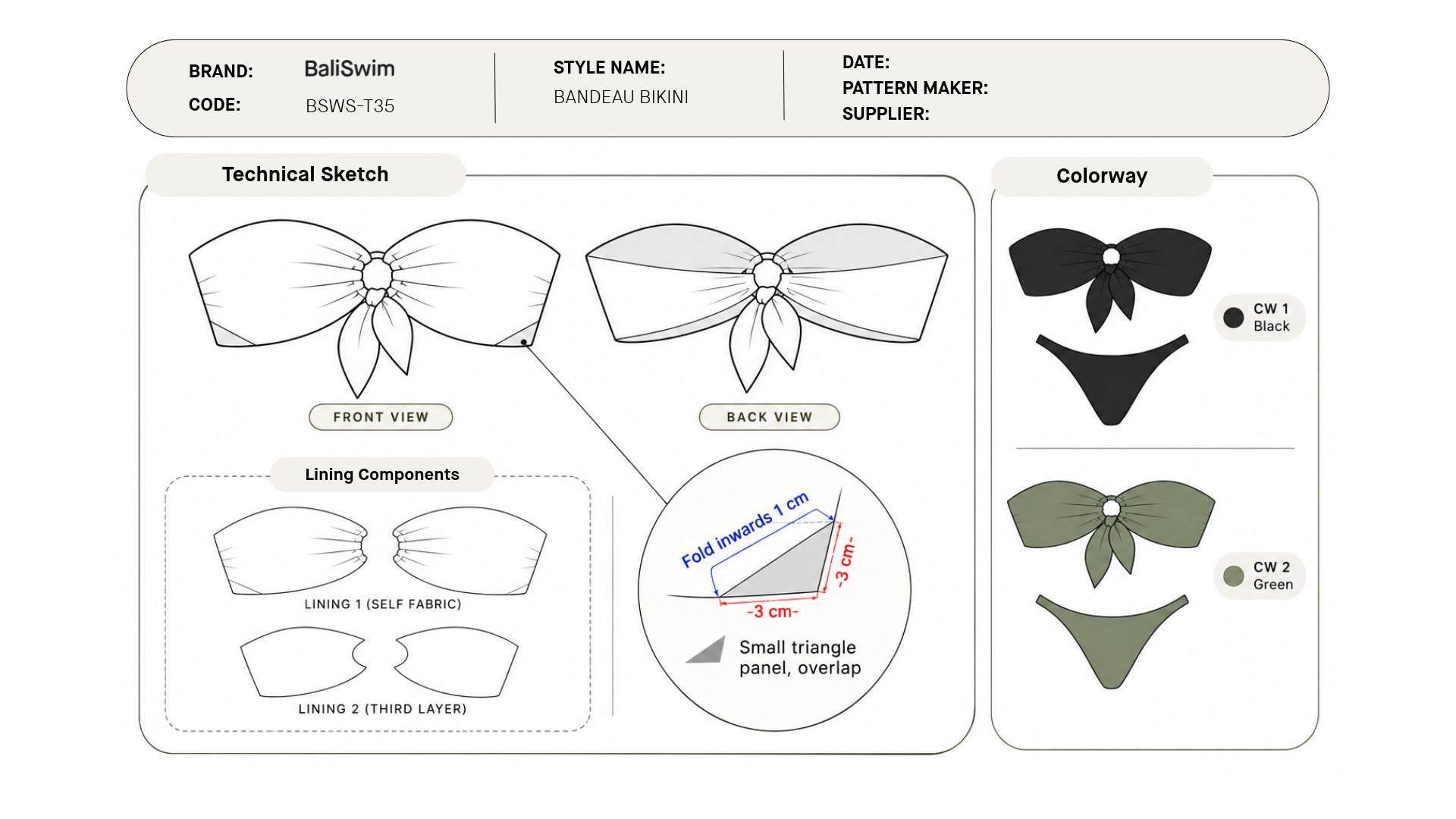
Sign up for our free catalog and you can download the template as a PDF. You can see exactly what’s inside it below, before you sign up.
What is a tech pack?
A tech pack is the instruction document a factory builds your swimsuit from. It covers flat sketches, materials, measurements for every size, construction and branding. If something isn’t in the tech pack, the factory has to guess.
A full tech pack covers your sketches and inspiration, fabric and accessories, measurements, logo placement, and the photos and comments from each sample review. A swimwear tech pack usually includes front and back flats, stitch and construction callouts, a measurement page and a bill of materials (BOM). It also gives fabric, lining, elastic, trims and hardware their own notes.
The simplest way to think about it: a tech pack is a photo of the finished product before the product exists. Anyone holding it should be able to picture your exact suit, down to the elastic in the leg opening and the label inside the back.
You’ll also hear it called a spec sheet, though strictly the spec sheet is just the measurements page.
Every blank in your tech pack turns into either a question from us or a guess on your first sample. Questions slow you down. Guesses cost you a round.
What’s in our free swimwear tech pack template?
Our free tech pack template has one section for each decision the factory needs from you. Fill it in top to bottom and you’ve answered most of the questions we’d otherwise send you by email.
| Section | What it tells the factory |
|---|---|
| Style info | Which style this is, which sizes and colors, and which version you’re on |
| Flat sketches | What the suit looks like from the front, back and inside |
| Materials (BOM) | Every fabric, lining, elastic, trim and piece of hardware |
| Construction and stitches | How each seam is sewn and how each edge is finished |
| Measurements and grading | Finished measurements for every size in your range |
| Colorways and prints | Each color, plus print scale and placement |
| Labels and packaging | Where your brand appears, inside and out |
| Sample comments | What changed after each sample round |
It’s built as a swimwear tech pack, not a general garment form, so lining, elastic and print placement each get their own space.
How to make a tech pack for swimwear, section by section
To make a swimwear tech pack, fill in eight sections in order: style info, flats, materials, construction, measurements and grading, colorways, labels, and sample comments. Each one answers a question the factory would otherwise ask you. Below is what to write in each, and the mistake we see most often there.
Style info
Start with the details that tie every page together. Give the style a name and a code, list the size range, and list every colorway you plan to produce. Then put a version number and date on every page, not just the cover. Add your name, email and the person who signs off samples to the first page.
The version number matters more than it looks. Tech packs change between sample rounds, and pages get printed, forwarded and pinned up next to machines. When a page has no version, nobody can tell whether it’s current.
Here’s a tech pack example of a finished style block:
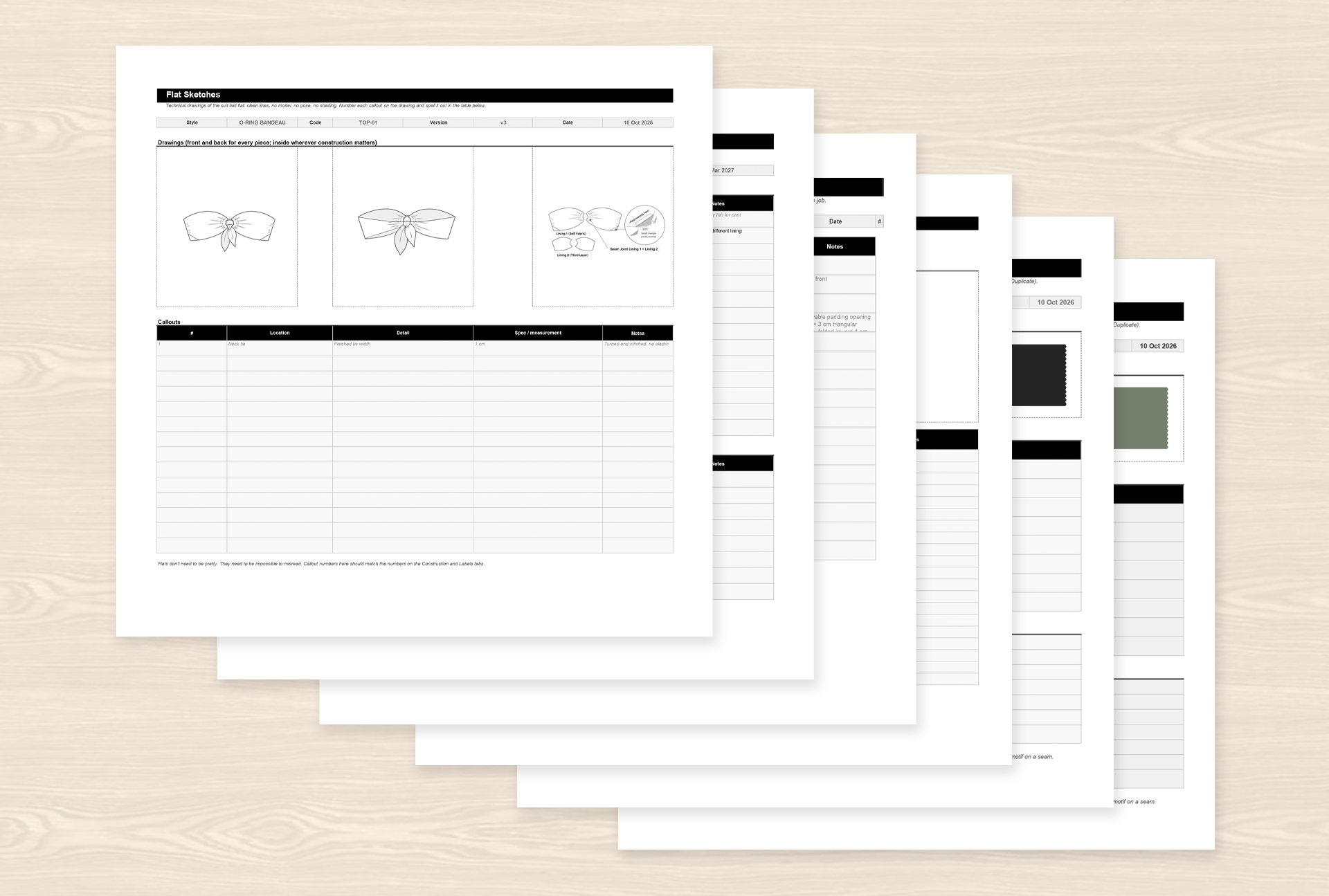
If your tops and bottoms sell separately, give them separate style codes.
Flat sketches
Flats are technical drawings of the suit laid flat. You need a front and a back for every piece, plus an inside view wherever construction matters, like a lining or a cup pocket. Use clean lines: no model, no pose, no shading. Add callouts pointing at every detail you care about, such as strap width, tie length or where a seam sits.
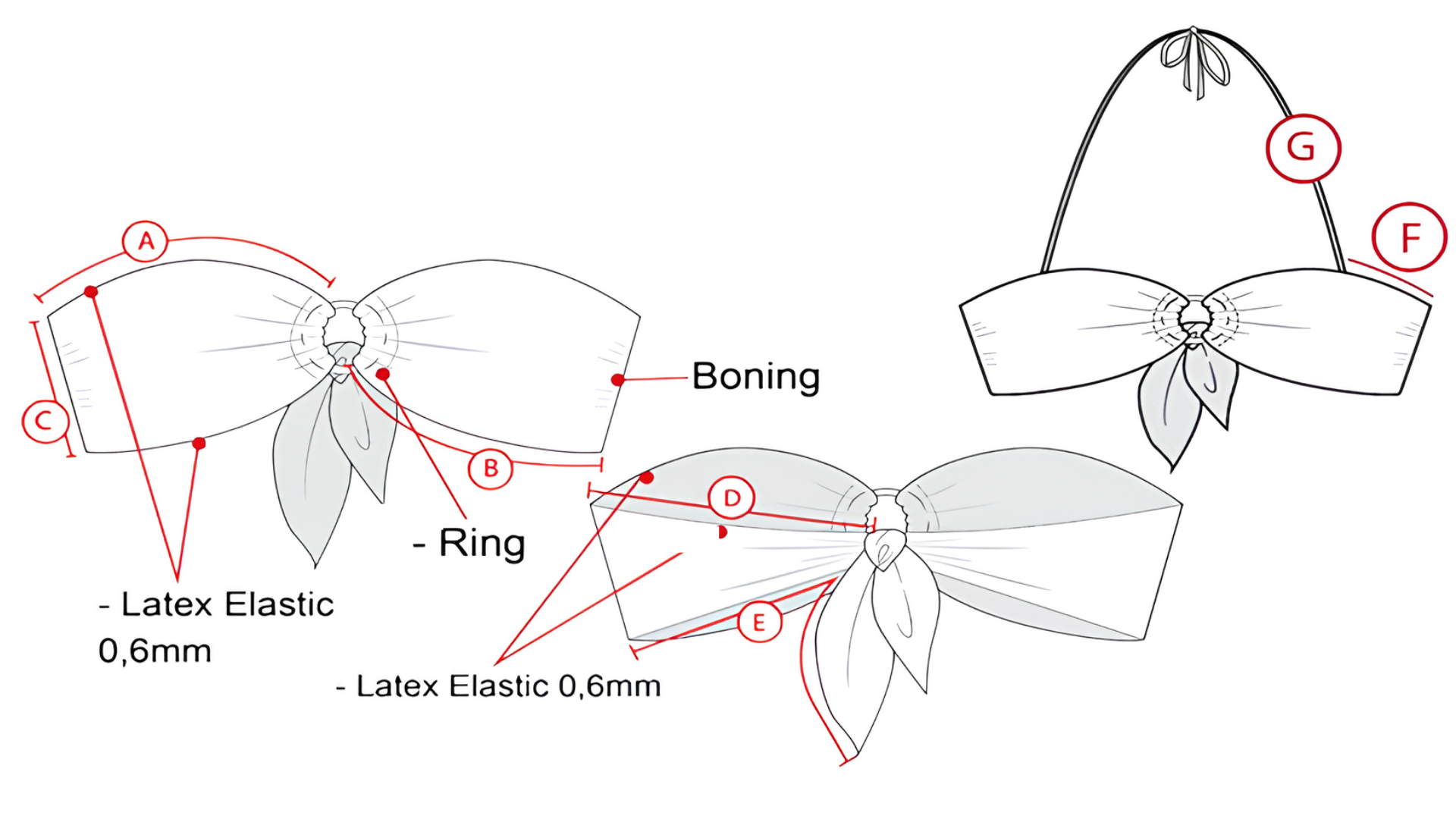
Flats don’t need to be pretty. They need to be impossible to misread.
What we see: Inspiration photos sent instead of flats. Three photos of three bikinis, each with a different strap, leg line and back. We can’t tell which detail you want from which photo, so we ask or we guess. Inspiration is useful for mood. Put it on its own page and let the flats give the instructions.
Materials (bill of materials)
The bill of materials lists everything that goes into the suit: main fabric, lining, elastic, trims and hardware. For each item, write what it is, where it goes and its color.
Choose your main fabric from our Fabric Explorer, which lists specs, colors and certificates for what we stock. Lining is simple: we line suits with the same fabric as the outside. If you want a different lining, list it here.
What we see: No elastic spec. Elastic decides how every edge of a swimsuit grips and finishes, and it’s often missing from the BOM. Without the type, width and placement for each edge, the factory has to choose for you. List the elastic for leg openings, neckline, underbust and straps separately, even if it’s the same elastic everywhere.
Construction and stitches
This section tells the factory how the suit goes together. Name the stitch type for every seam, and say how every edge is finished. Callouts on your flats work well: draw a line to each seam and write the stitch next to it.
Our guide to swimwear stitch types covers the common ones and where each is used.
Chose a stitch for a reason? Write it down, whether it’s a flat seam where it touches skin or a visible topstitch for the look. That gives us room to suggest an alternative that does the same job if your first choice doesn’t suit the fabric.
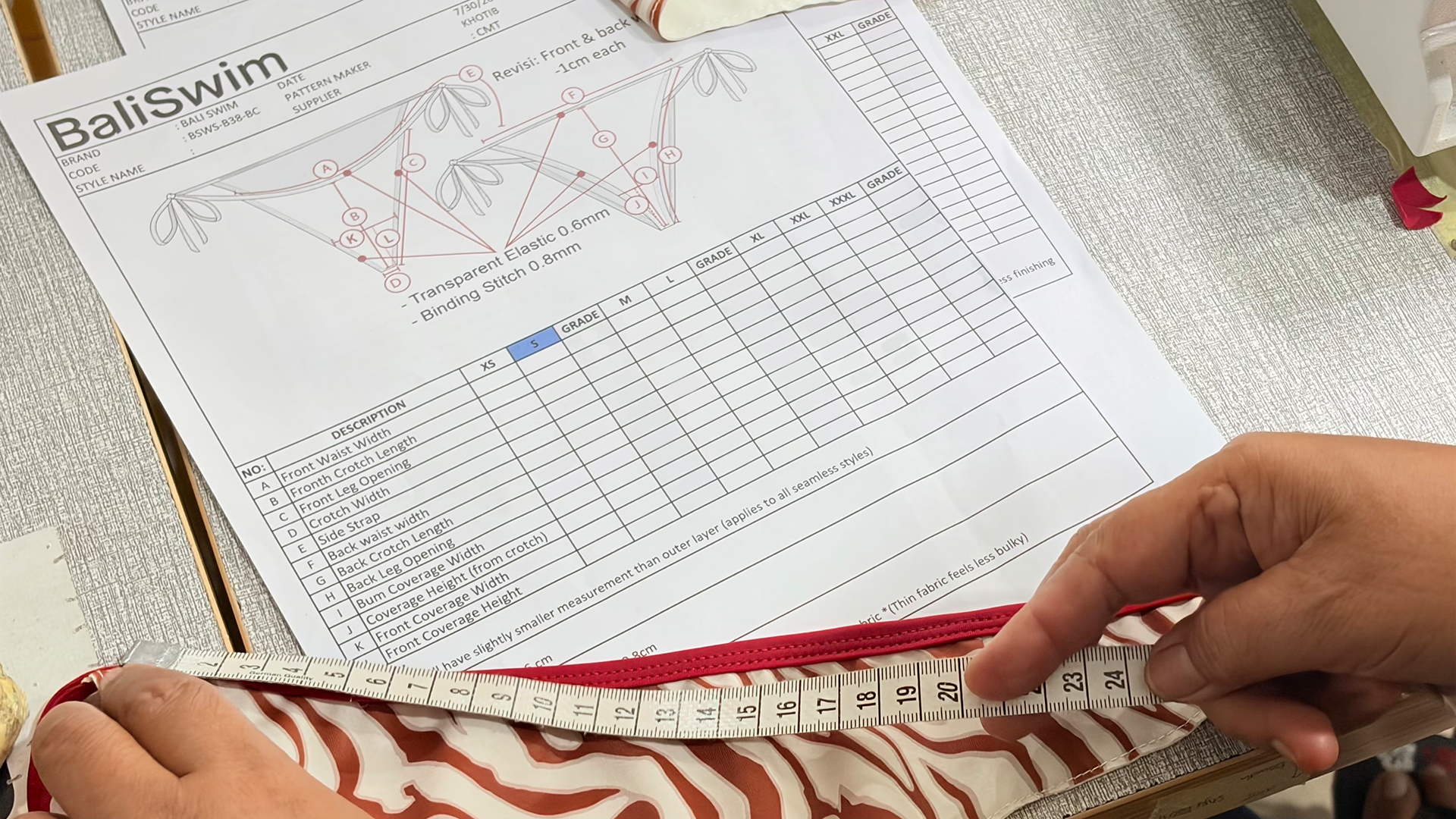
Measurements and grading
This is the page that decides whether your first sample fits. Follow three rules.
- Use finished garment measurements. You’re describing the suit, not the person wearing it.
- Measure flat and relaxed. Garments with elastic are usually measured without tensioning the elastic. Swimwear is built with negative ease, meaning the suit is smaller than the body and stretches to fit. Stretching it while you measure inflates every number.
- Code every point of measure (POM). Give each one a code, a short written description and a small how-to-measure drawing. “A: Waist, measured straight across, edge to edge” leaves nothing to interpret.
Then grade: fill in measurements for every size in your range, not just your sample size. If you already have a swimsuit size chart, build your grading from it.
What we see: Body measurements sent instead of garment measurements, or a garment measured while stretched. Either way, the first sample comes back the wrong size. The other one is a single size measured with the rest of the range left blank. With one column, we’d have to guess how every other size steps up or down.
Colorways and prints
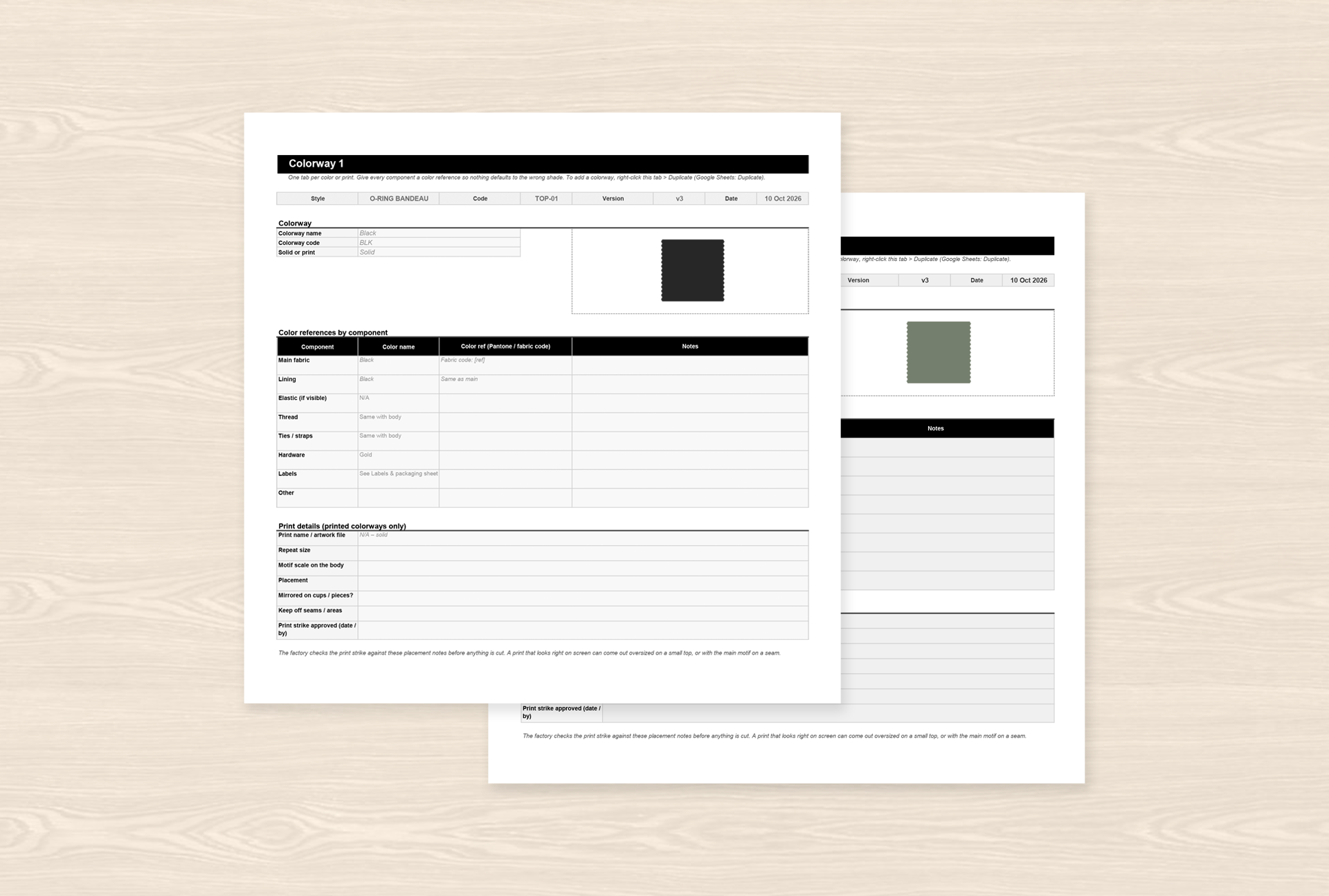
Give each colorway its own page, with color references for fabric, lining, elastic and trims, so nothing defaults to the wrong shade.
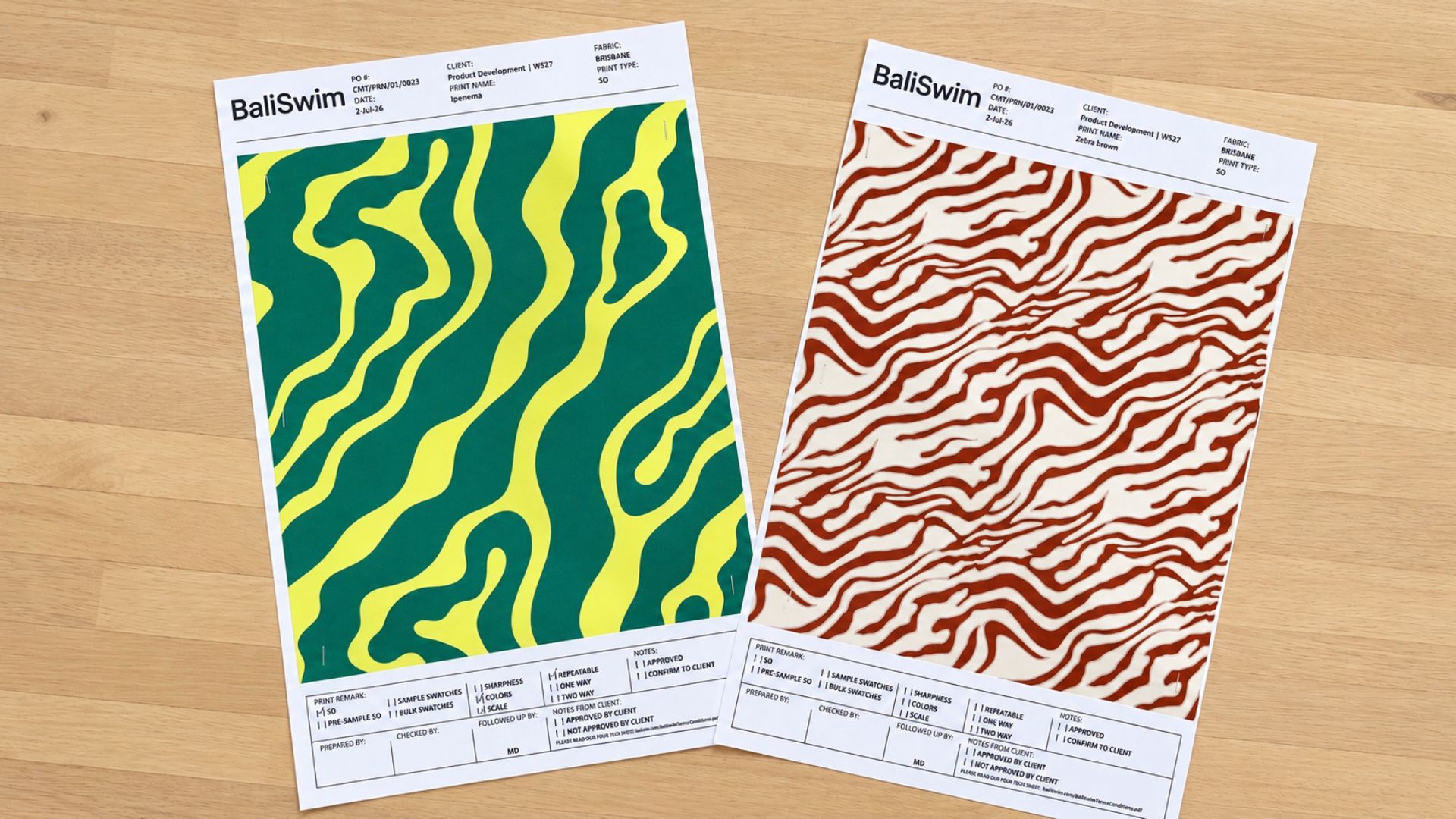
For prints, tell us three things: the print type, the scale and the placement.
Print type decides how much fabric each suit uses, and that drives your cost. There are three options:
- 2-way repeat prints look right in either direction, so we can turn pattern pieces to fit them closer together on the fabric. They use the least fabric, which is why they’re the most popular choice.
- 1-way repeat prints have a clear up and down, so every piece has to face the same way. We can do it, but expect higher fabric consumption.
- Placement prints are designed to land in an exact spot on the suit, like a motif centered on each cup. Every piece has to be cut around the print, so they use the most fabric and cost the most.
Scale is how big the motif is on the body. Placement is where key motifs land: centered on the front, mirrored on the cups, or kept off the side seams. Even an all-over print needs placement notes if you care where the main motif sits.
We print women’s styles in-house in Bali on Carvico Brisbane Recycled. Before anything is cut, we send you a strike-off to approve. Your print notes are what we check it against.
A cost note: our minimum is 20 pieces per style per color or print, with no minimum per size. Every colorway you add is another 20 pieces.
What we see: Printed colors that don’t match what brands saw on screen. Screens and fabric show color differently, so a print can come out brighter, duller or a shade off. Scale catches people out too: a motif that looks right on screen can come out oversized on a small top. Every print needs your strike-off approval before production, and your print notes are what we check it against.
Labels, branding and packaging
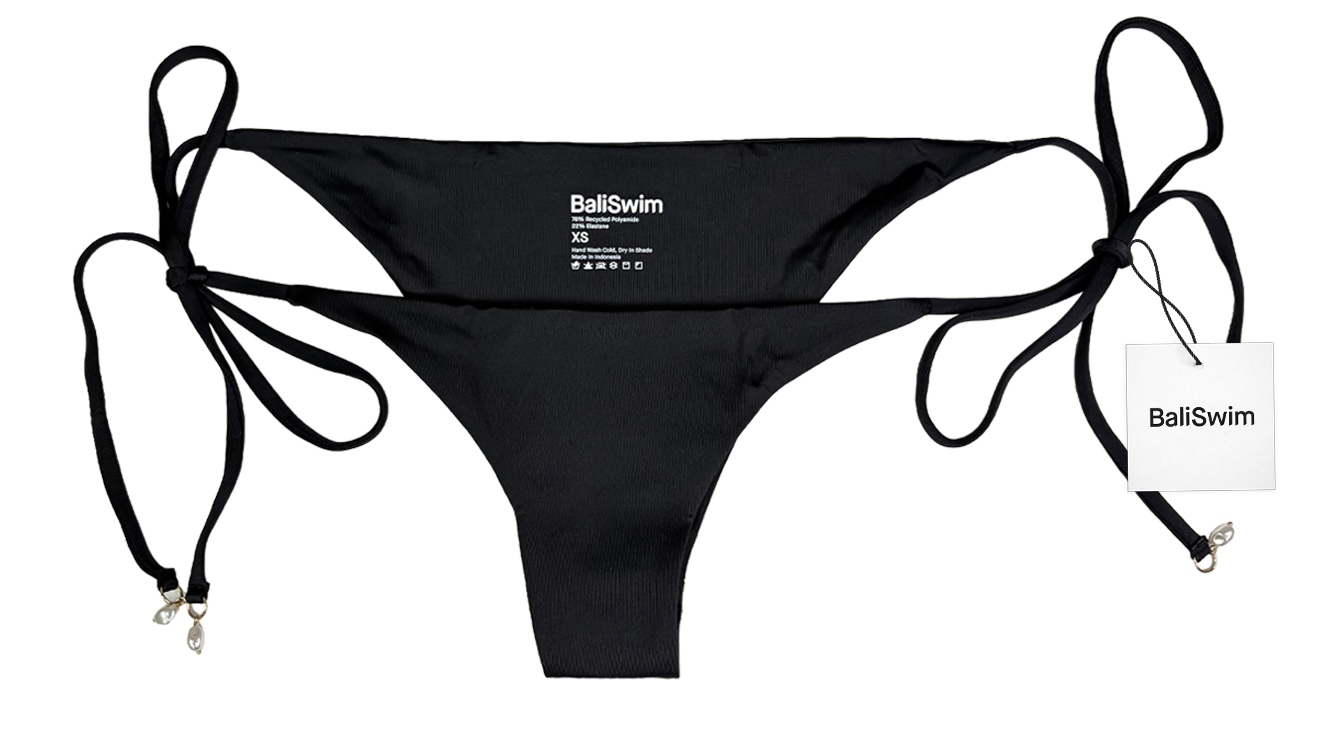
Show every place your brand appears: main label, size label, care label, hang tag and any logo on the outside of the suit. For each one, mark its position on the flat, its size and how it’s attached. Add packaging details too, like polybags and inserts.
Be exact about label position. In swimwear, a label in the wrong spot can sit right where a tie fastens or peek out at the back neckline. To see how different cuts are built, browse our bikini and swimsuit styles.
Sample comments
You fill this section in after the first sample arrives, and you keep filling it in. For each round, log the date, the version, what you checked and what needs to change. Add photos from each round. Photos with arrows beat paragraphs.
Most styles take 2 to 3 sample rounds. Clear comments make each round count. “Leg feels tight” gives us little to work with. “Leg opening, POM D: increase on all sizes, new numbers in the v4 size table” tells us exactly what to change. Once a round is signed off, move the change into the measurements page and update the version number.
For what happens between rounds, see how sampling works.
Is your tech pack ready to send? A quick checklist
Before you send it, check that someone outside your team could build the suit from the tech pack alone. If they’d need to call you to finish it, it isn’t finished.
Run your tech pack through these 10 checks before you hit send:
- Every page shows the style code, version number and date.
- Every piece has front and back flats with callouts, and inspiration photos sit on their own page.
- The BOM lists main fabric, lining, trims and hardware, with a color for each.
- Elastic is specified by type, width and placement for every edge.
- Every seam has a stitch type and every edge has a finish.
- Measurements are finished garment measurements, taken flat and relaxed.
- Every POM has a code, a description and a how-to-measure drawing.
- Every size in your range is graded, not just the sample size.
- Each colorway has its own page, and printed styles include scale and placement.
- Your name, email and the person who signs off samples are on the first page.
Do you need a tech pack to work with a swimwear manufacturer?
No. We accept a sketch with no tech pack at all. A complete tech pack just means fewer questions and a clearer first sample.
If you start from a sketch, you’ll still answer the same questions this template asks. You’ll answer them during sampling instead of upfront.
The honest trade-off: for core styles like a triangle bikini, a classic one-piece or a high-waist bottom, you can fill in this template yourself. For complex builds, such as underwire, molded cups, hardware-held cutouts or engineered prints, a freelance technical designer is often worth the money. They speak construction language and will catch gaps you can’t see yet.
Our guide on how to start a swimwear line covers what comes before the tech pack. How sampling works covers what comes after.
Frequently Asked Questions
- What’s the difference between a tech pack and a spec sheet?
A tech pack is the whole document: sketches, materials, construction, measurements, branding and sample comments. The spec sheet is the measurements page inside it. If a factory asks for a spec sheet, check whether they mean the full pack.
- How many pages should a swimwear tech pack be?
- It depends on how complex the style is. Freelance swim tech packs run from about 6 pages to 15 or more, and only the larger ones usually include measurements and grading. Coverage matters more than page count.
- Do I need a separate tech pack for each colorway?
- No. Use one tech pack per style, with a separate colorway page for each color.
- Can I make a tech pack in Excel or Google Sheets?
- Yes, for most of it. Style info, the BOM, measurements and sample comments all work in a spreadsheet. Flat sketches need a drawing tool or clean scans of hand drawings, added as images.
- Should I hire a tech pack designer?
- Hire one for complex builds or a large first collection. For a few core styles, the template will get you there, and you can always start with a sketch.Get the template with our free catalog
- No tech pack yet?
- Send us your sketch